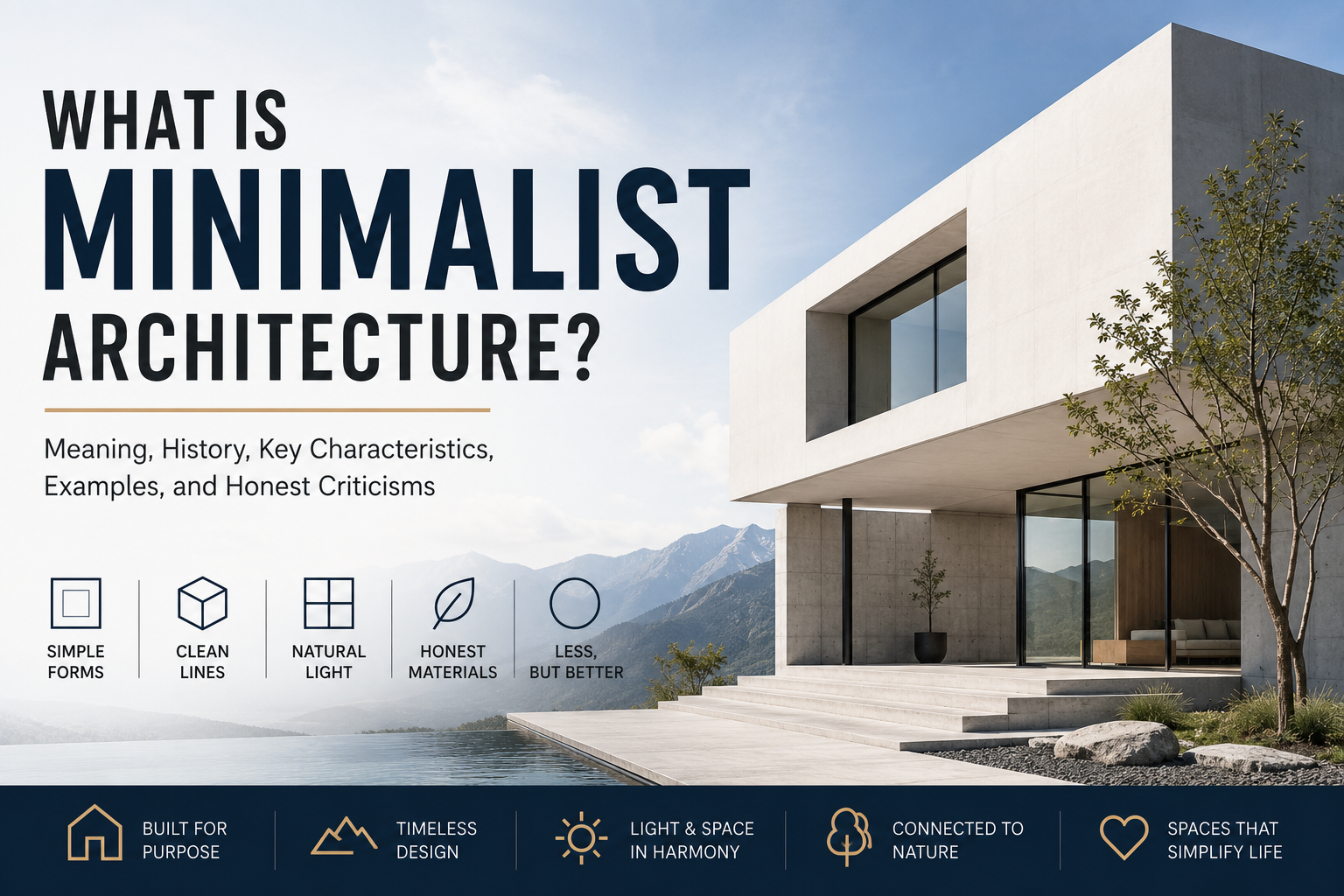
Minimalist architecture means design stripped down to what a building truly needs. Clean lines, plain materials, open space, and no extra parts. Every wall, window, and beam has a job. If it does not, it is not there.
You walk into a room. Bare concrete. One window. Nothing else. Something in you settles. That quiet is not luck. That is minimalism architecture at work. Not flash. Not show. Just the building cut down to what it truly needs. If you want to know what is minimalist architecture style, this is it at its core.
What Is the Meaning of Minimalist Architecture?
So what is the meaning of minimalist architecture? It is not a look. It is a decision. Every part of the building has to earn its place. A wall. A window. A beam. If it does not do anything, it does not belong. That sounds simple. In practice, it is one of the hardest things to build well.
Minimalist architecture explained properly starts with two movements from the early 1900s. Bauhaus kicked off in Germany in 1919. Walter Gropius built it around one core idea: function first. No decoration that does not serve the structure. De Stijl started in the Netherlands two years before. It worked with basic shapes and a very tight color range. Both pushed the same way. Get rid of the noise. Find what is underneath.
History of Minimalist Architecture
Ludwig Mies van der Rohe took those ideas and ran. Less is more was his phrase, and it became the whole language of minimalism in architecture. He worked with glass and steel. He blurred the wall between inside and outside. His buildings had no extra trim. The structure itself was the design. The Farnsworth House in Illinois from 1951 is a glass box on steel legs. Nothing extra. Every detail is the point.
Tadao Ando carried that further with raw concrete and cut walls that let light do the work. No paint, no trim.
Minimalism Architecture and Other Minimalist Movements
The relationship between minimalist architecture and other minimalist movements is not a fluke. It is the same idea spreading across fields at the same time. In the 1960s, Donald Judd made art from plain steel boxes. Frank Stella painted flat shapes and added nothing beyond what the shape asked for. None of them were building. But all of them were doing what Mies had done. Cut until you hit the core.
Which architectural styles are minimalism typically associated with? The closest are modernism, the International Style, Brutalism, and old Japanese design. They all put honest materials first. They all treat extra trim with doubt. Brutalism goes heavy and raw where minimalism goes light and precise. But the start point is the same. Use what is real and stop there.
Before starting any project in this style, knowing how much does an architect cost will stop sticker shock when the first quote comes in.
Characteristics of Minimalist Architecture
The characteristics of minimalist architecture show up the same way in every decade and every climate:
- Clean lines. No trim that does not have a job.
- Simple shapes. Boxes, flat roofs, plain planes. The form says it all.
- Plain materials. Concrete, glass, steel, stone, wood. Not painted over or dressed up.
- Open space. Empty parts of a minimalist room are not wasted. They do work.
- Natural light. Windows are placed on purpose. Light moves through the day and becomes part of the building.
- No extra parts. Every detail that adds nothing gets cut.
These minimalist architecture principles sum up what minimalism architecture is really about. Not rules from a list. They are a way of thinking. Minimalist design architecture starts from the same place every time. If a building is honest about what it is, it does not need to hide behind anything.
The whole thing depends on what gets drawn before the build starts. Solid architectural drafting is not a step to rush. It is the base everything else rests on.
Modern Minimalist Architecture Today
Modern minimalist architecture has softened since the cold glass and concrete of the mid-century. Warm wood shows up now. Stone with texture. Sand and cream instead of sharp white. The minimalist house architecture being built today is easier to live in. That is not a trade-off. It is the style growing up.
Benefits of Minimalist Architecture
The benefits of minimalist architecture are practical as much as they are visual:
- Less to fix. Fewer surfaces means fewer things to go wrong over time.
- Lower long-term cost. A simple building in honest materials holds up better than a heavily trimmed one.
- Light and space do more. Without clutter, the ceiling feels taller and natural light actually lands.
- Less waste on site. Fewer materials, fewer layers, less scrap going to a skip.
- Strong resale. Clean minimalist building design draws a wide range of buyers.
Every surface in a minimalist project is on show from day one. That means every line in the drawing has to be right. Architectural drafting services in Park City work with clients to get those details locked before the build begins.
How to Design Minimalist Architecture
How to design minimalist architecture trips people up. They think it means taking things away from an existing plan. It does not. It means starting with nothing and only adding what the building truly needs. Structure first. Then light. Then material. Then stop. Every move after that should make the space simpler and clearer.
If you are still working out what kind of space you want, reading about what is home interior design and how it ties to the build helps clarify things before you commit to a direction.
What Are the Criticisms of Minimalist Architecture?
The minimalist architecture style has real critics. What are the criticisms of minimalist architecture? Three come up most often. It can feel cold and hard to live in day to day. It does not hide mistakes because every surface is on show. And it costs more than people think. Simple buildings need near-perfect work. There is no trim layer to cover an error.
Why are interior designers ditching minimalism? Some of them are. The all-white bare-shelf look of the 2010s started to feel too clinical. Warmer styles moved in fast. But minimalist architectural design has not gone away. It has just moved past the harsh version. Less cold, more honest.
Minimalist Architecture vs Modern Architecture
Minimalist architecture vs modern architecture gets mixed up often. Modern architecture is a time frame. It ran from about 1920 to 1970. Minimalism architecture is a way of thinking that grew out of it and kept going. The Glass House Philip Johnson built in 1949 is both. Most mid-century modern homes are modern but not truly minimalist. Clean lines are not the same as true reduction.
What Does the Bible Say About Minimalism?
Not much in direct terms. But ideas about living simply, not hoarding, and not putting weight on objects run through a lot of it. Some people draw a line from those ideas to minimalist living and then to minimalist home architecture. The link is loose but it comes up enough to note.
FAQ
What is minimalist architecture?
Design that uses only what is needed. No extra trim, no part that does not have a job. Each piece earns its place or gets cut.
What are the main characteristics of minimalist architecture?
Clean lines, simple shapes, plain materials like concrete and glass, open space, and light placed with care. Every part has a clear role.
Is minimalist architecture the same as modern architecture?
Not quite. Modern architecture is a time period, about 1920 to 1970. Minimalist architecture came from it and kept going. They are close but not the same.
What are the criticisms of minimalist architecture?
It can feel cold and hard to live in. Mistakes are hard to hide since every surface is on show. It also costs more to build than most people think.
Why are designers moving away from minimalism?
The all-white bare look of the 2010s felt too sterile for many people. Warmer styles moved in. But clean, honest design has not gone away. It has just become less extreme.
Which styles is minimalism most linked to?
Modernism, the International Style, Brutalism, and old Japanese design. All of them put honest materials first and treat extra trim with doubt.
Conclusion
Minimalist architecture asks one question of every part of a building. Does this need to be here? If the answer is no, it goes. What stays is a space where light, material, and form do all the work. No cover. No noise.
That kind of building takes real thought and real craft to pull off. Cheap versions look empty. Good versions feel like a breath of fresh air.
If you want spaces that are calm, honest, and built to last, reach out to the Landmark Home Design team. We work with clients across the mountain west to get these choices right from the first drawing.